Guide
Direct Mail for Self Storage: A Guide for Storage Operators
What self storage direct mail is, who is worth reaching, what belongs on a postcard, and how mail fits alongside the digital advertising you are probably already running.
Definition
What is self storage direct mail?
Self storage direct mail is physical mail sent to households or businesses near a storage facility to promote the units it has available. In practice this almost always means a postcard, because a postcard needs no envelope, is read without being opened, and carries about as much information as a storage offer requires.
There are two broad ways to do it. In targeted mail, specific addresses are selected using data — households of a particular type, within a particular area, matching particular characteristics — and each piece is addressed to that recipient. In saturation mail, including USPS Every Door Direct Mail, an identical piece goes to every address along chosen postal carrier routes, with no selection inside the route.
Targeted mail buys precision. Saturation mail buys coverage. Neither is universally better, and the choice usually comes down to how specific the audience for a campaign really is. Filling RV spaces is a targeting problem. Announcing a brand-new facility to a neighborhood is often a coverage problem. We compare the two in detail here.
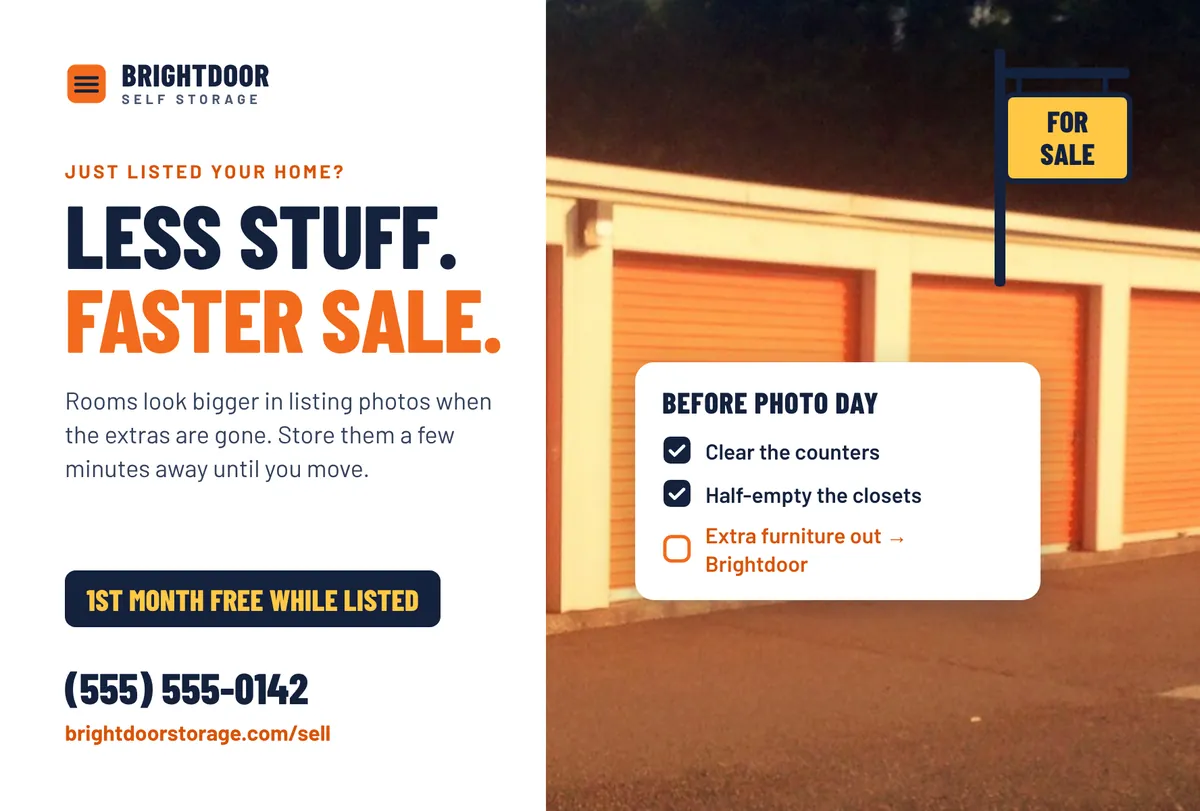
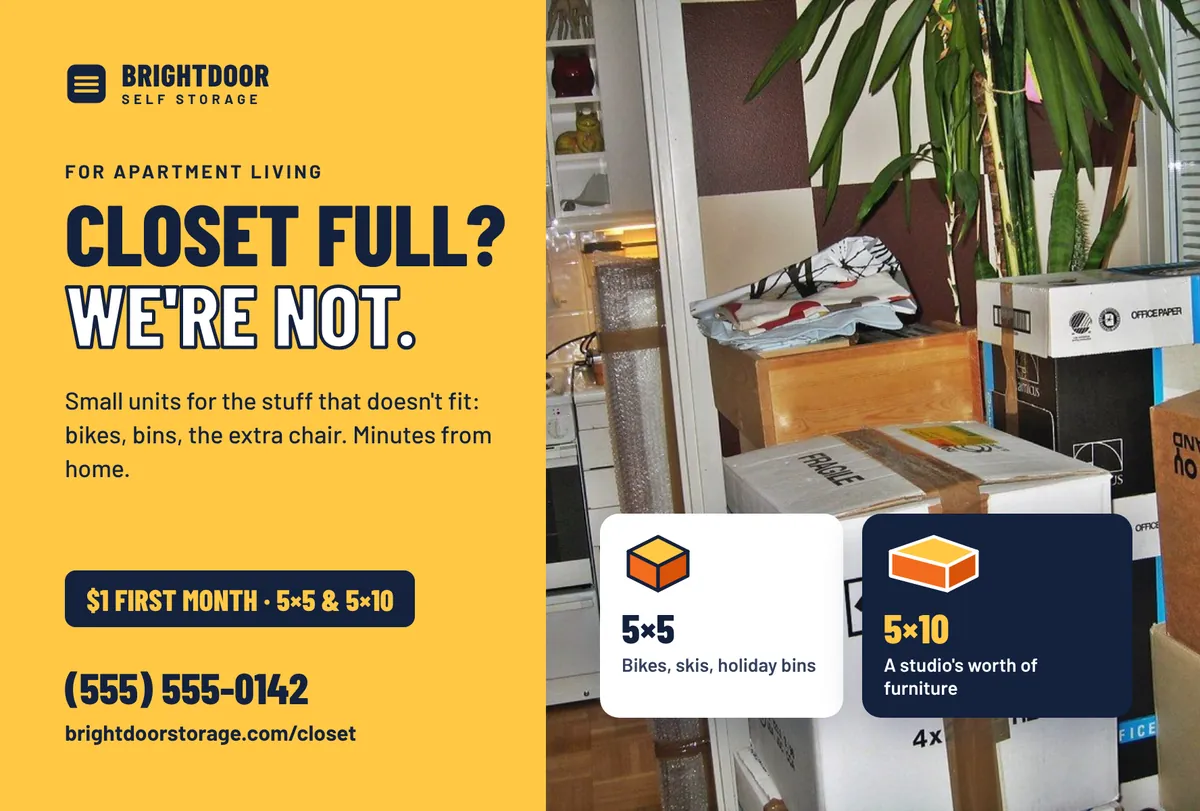
A storage postcard has one job: name the facility, name the space, give a reason to act, and make responding easy. Sample design for a fictional facility.
Why Operators Use It
Why storage operators use mail at all
Almost every marketing channel available to a storage facility waits for the customer to raise their hand first. Paid search, organic search, marketplace listings and map results all depend on somebody deciding they need storage and going looking. That demand is real and worth competing for, but it is a fixed pool, and every facility in your market is bidding for the same people.
Mail is one of the few channels that can reach a household before that decision. Storage need is usually created by a circumstance — a move, a renovation, a new boat, an over-committed garage, a business outgrowing its back room — and the gap between the circumstance and the search can be days or weeks. A postcard that arrives in that gap is doing something paid search structurally cannot.
There is a second, more practical reason. A storage facility has a small, precisely definable market: the households and businesses within a short drive. Very few advertising channels let you aim at exactly that footprint without wasting most of the spend on people who will never rent from you. Mail does, down to the carrier route.
Fill By Mail is built to make that channel simple for independent operators: a published price per mailed piece, no monthly fee, no quantity minimum on targeted mail, and you pay when you mail.
Audience
Who is worth mailing
Storage demand clusters around circumstances rather than demographics. These are the groups most storage campaigns are built around.
People in the middle of a move
The single most common trigger for a first storage rental. A move creates a gap between leaving one space and settling into another, and storage fills it.
Renters and apartment households
Typically the least storage space per household of any group in your area, and the most likely to need somewhere for seasonal or bulky items.
Homeowners nearby
Renovations, downsizing, inherited furniture, a garage that has stopped fitting a car. Ongoing rather than one-off demand.
Boat, RV and vehicle owners
A narrower audience with a very specific problem — and one that HOA rules and driveway space frequently create for them.
Local businesses
Contractors, e-commerce sellers, service businesses and offices needing inventory, equipment or file storage without signing a commercial lease.
Households in a defined radius
The baseline. Everything else is a refinement of the simple fact that your market is the area within a short drive of your gate.
Campaign Ideas
Campaigns by unit type and situation
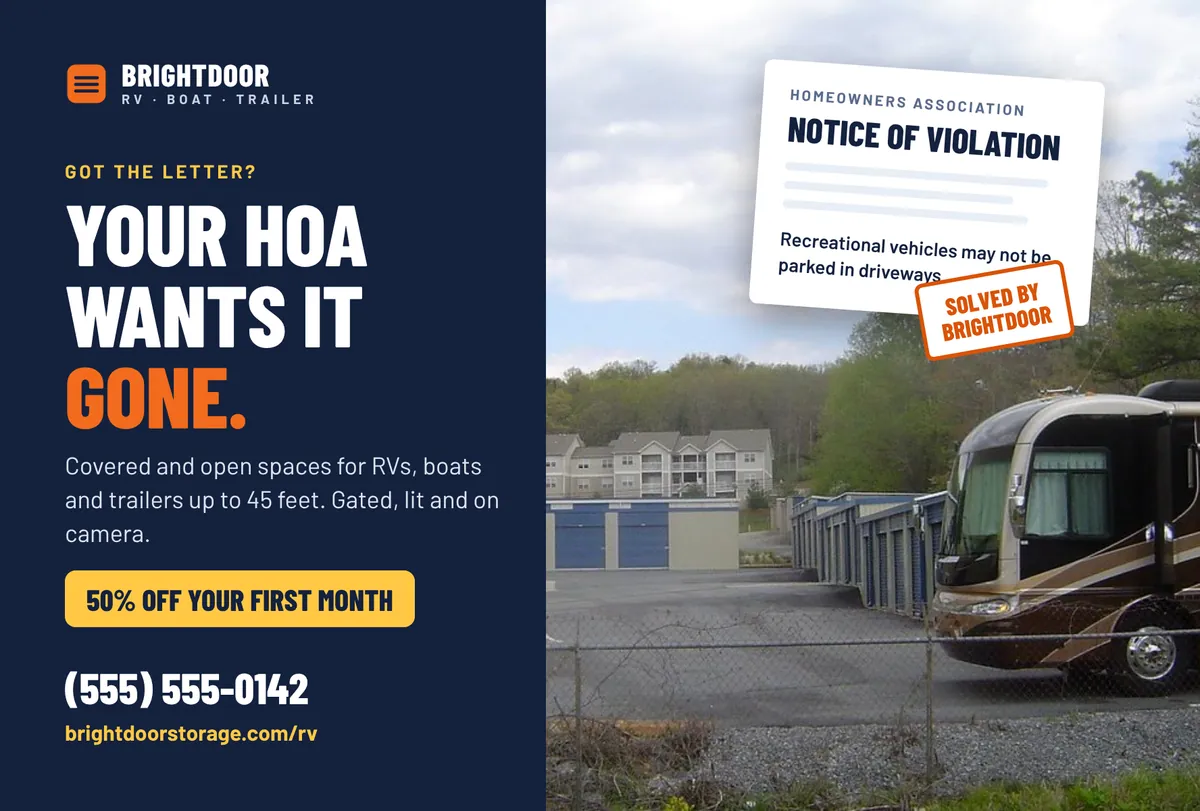
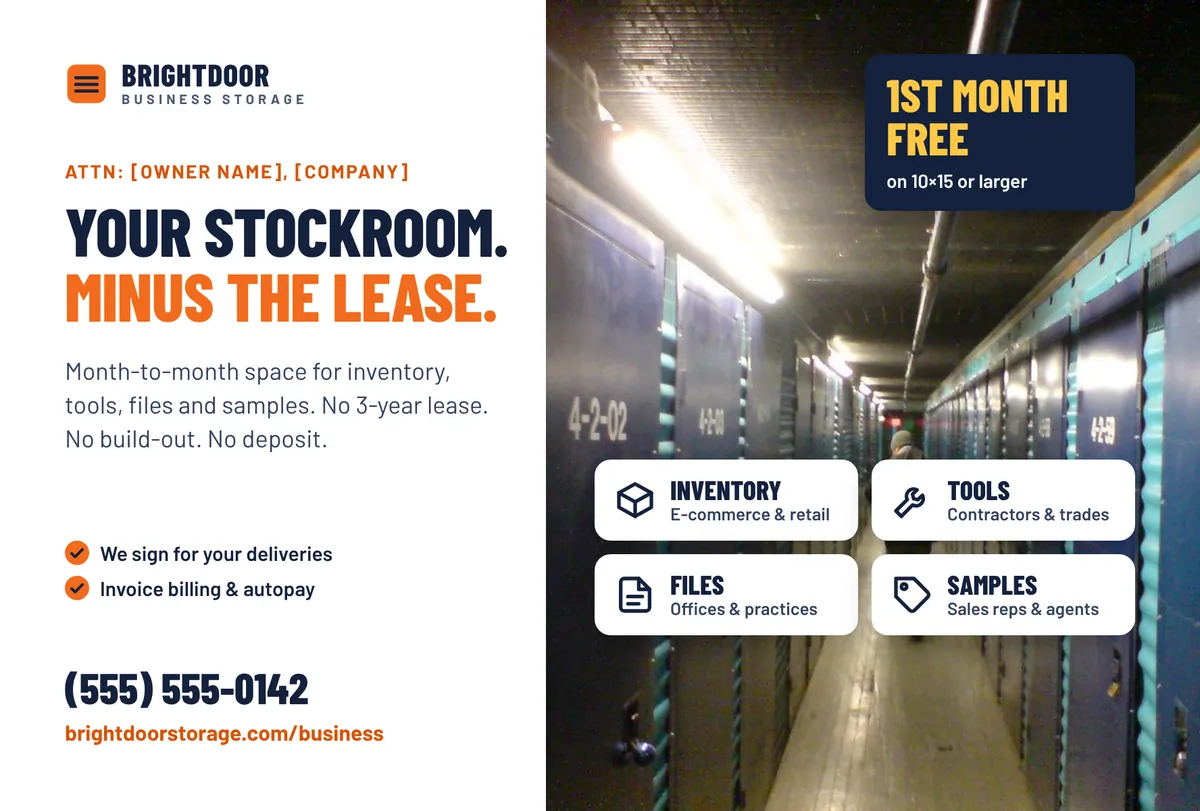
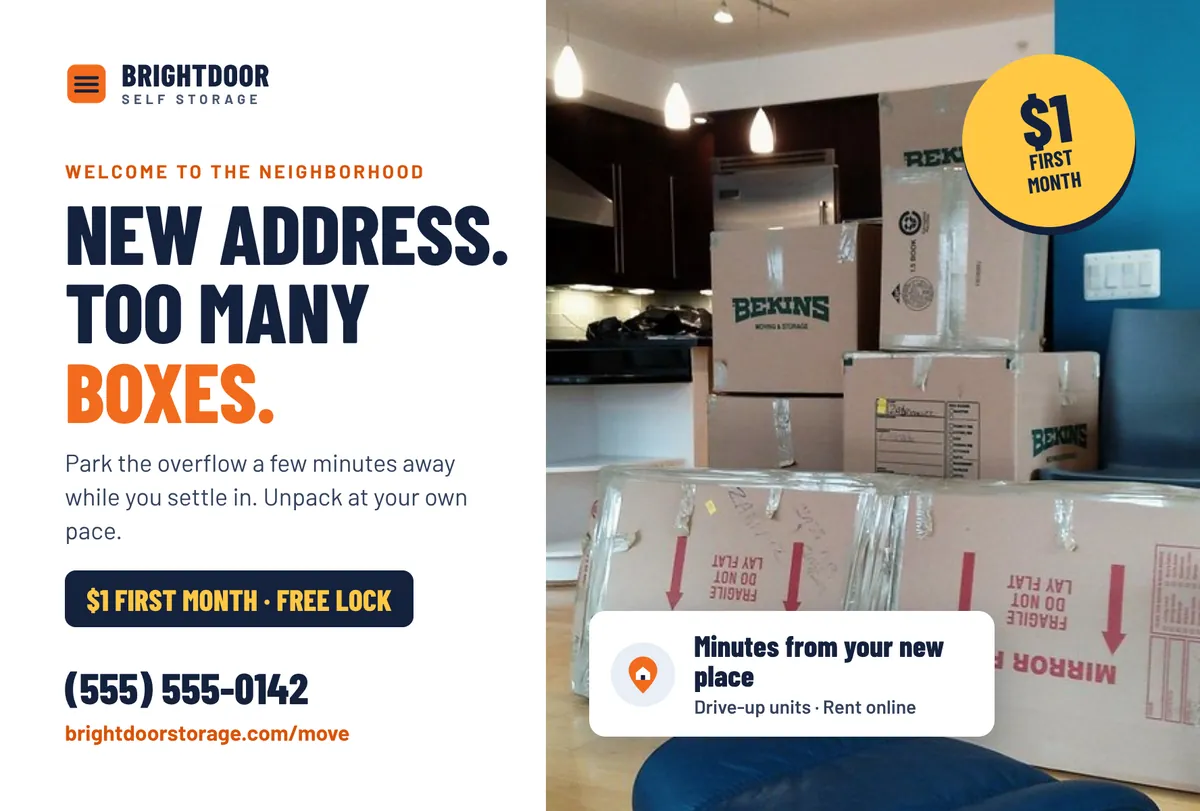
The most common mistake in storage mail is one postcard for everything. Inventory that is hard to fill usually needs its own message and its own audience.
- Self storageGeneral unitsNearby households who need more space than they have
- Drive-upGround-floor unitsPeople loading from a car, moving bulky items
- Climate-controlledInterior, temperature-controlledHouseholds storing furniture, documents, electronics
- RV & boatOversized vehicle spacesOwners out of driveway space or up against HOA rules
- VehicleParking and trailer spacesSecond cars, trailers, project vehicles
- BusinessInventory and equipment unitsLocal businesses avoiding a commercial lease
- Lease-upA whole new facilityEveryone nearby who does not know you exist yet
- New moverShort-term demandHouseholds arriving in or moving within your area
Creative
What belongs on the postcard
A postcard gets a second or two of attention while it travels from the mailbox to a counter. That constraint should drive every decision about it. One idea, stated plainly, beats a complete feature list every time.
Four things have to be present: who you are and where — storage is chosen by proximity, so a cross-street or landmark often works harder than an address; what kind of space is available; a reason to act now rather than eventually; and a response path so obvious it requires no thought.
The reason to act is where most storage postcards fall down. “Now leasing” is a statement, not a reason. Specific availability, a defined offer, or a seasonal hook all give the reader something to do with the information.
Comparison
Direct mail versus digital advertising for storage
These are complements, not alternatives. The useful question is not which is better but which job each one is doing.
| Comparison | Direct mail | Paid search |
|---|---|---|
| Reaches | Nearby households you select | People actively searching for storage |
| Timing | Before or around the moment the need appears | At the moment of the search |
| Intent signal | None — you are creating awareness | Strong — they typed the query |
| Geographic control | Precise, down to carrier route | Good, but bounded by how the platform infers location |
| Competitive pressure on cost | Not bid-based | Bid-based; cost rises with local competition |
| Best suited to | Lease-up, hard-to-fill unit types, sustained local presence | Capturing existing demand efficiently |
| Main limitation | No intent signal; needs repetition | Limited to the size of existing search demand |
If you can measure it, compare the two on cost per move-in rather than on cost per click or cost per piece — those are inputs, not outcomes. Estimate cost per move-in.
How Fill By Mail Works
Running a storage mail campaign with Fill By Mail
- 01
Choose your audience
Choose the area around your facility and the kind of household you want to reach, using household, property and financial filters.
- 02
Choose your postcard
Start from one of our self storage postcard examples, send the design you already have, or let us design one at no extra charge.
- 03
Choose how many
Send one, twenty, hundreds or thousands. There is no quantity minimum and no volume tiers.
- 04
We handle the mail
Fill By Mail handles the data, printing, address processing, postage and mailing.
Why the pricing is a single number
Conventional mail quotes separate data, printing, postage, address processing and handling — which makes it genuinely hard to know what a campaign costs until it is nearly booked. Fill By Mail puts all of that inside one per-piece price so the math is the piece count.
targeted postcard
- Your own campaign account included
- Account setup included
- Targeting setup included
- Audience/data help included
- Postcard design included
- First campaign setup included
- Campaign reporting and matchback included
- No signup fee
- No setup fee
- No mailing quantity minimum on targeted mail.
Prices are per mailed piece, with printing, postage and postcard design included. No monthly fee.
Before You Mail
A short checklist
- Decide which units you are actually trying to fill, and mail for those specifically.
- Define the area you realistically serve — not the area you would like to serve.
- Pick one audience per campaign rather than combining several into one list.
- Write one offer with a reason to act now, and cut everything else from the card.
- Put a QR code and a phone number on the piece, and make sure both land somewhere useful.
- Decide how you will know it worked before the mail goes out, not after.
Questions
Direct mail for self storage: questions
Is direct mail still effective for self storage?
Direct mail remains a working local channel for storage because the purchase is geographic and often triggered by a life event rather than a search. That said, effectiveness is specific to your market, your offer and your audience — anyone quoting you a universal response rate for self storage is quoting something that has not been independently established for this industry. Treat mail as a channel to test and measure rather than one with a guaranteed outcome.
How many postcards should a storage facility mail?
Traditionally the answer was dictated by print minimums rather than by strategy. A more useful approach is to start from the audience: how many households or businesses in your area genuinely fit the campaign you want to run? With Fill By Mail there is no quantity minimum, so the count can be whatever the audience actually is — whether that is 40 prospects or 4,000.
How often should a storage facility mail?
Repetition matters more in mail than in most channels, because you are reaching people before they are looking rather than at the moment they search. A single drop reaches a household once, at a moment that may or may not be relevant. Recurring or always-on mailing raises the chance that your facility is in front of someone when their circumstances change. The right cadence depends on your budget and the size of your addressable area.
Is direct mail better than Google Ads for self storage?
They do different jobs and the honest answer is that most facilities benefit from both. Paid search captures people who are already looking for storage — high intent, but limited to existing demand and priced by competition. Direct mail reaches nearby households regardless of whether they have started searching, which makes it useful for creating awareness and for lease-up, but it does not have search's intent signal. Comparing them on cost per click or cost per piece is not meaningful; compare them on cost per move-in if you can measure it.
What information do I need before starting a direct mail campaign?
Your facility address, the unit types you need to fill, the geographic area you realistically serve, and a reason for someone to respond now. That last item is the one most often skipped. A postcard that says only that a facility exists gives the reader nothing to act on.
Do I need my own mailing list?
No. Use our targeting data — household, property, financial and geographic filters — or upload your own address list and mail to it.
More on pricing, postcard examples and targeting in the Fill By Mail overview.
Get Started
Start With the Prospects You Already Have
Pick your audience and your quantity — one piece or thousands, 89¢ each on targeted mail, with no monthly fee, no signup fee and no mailing minimum.